

Shop by Goal
Shop by Category
Shop by Ingredient
Here's 10$ off from your friend
Discount code copied!
* This offer expires in 3 days
Home/Blog/A Beginner’s Guide to Strength Training
A Beginner’s Guide to Strength Training
By Ethan Boldt
April 24, 2026
According to the CDC, only about 31 percent of U.S. adults lift weights at least twice a week. And that’s probably generous, with some fitness experts saying the participation is under 10 percent.
In other words, there are many people who are new to strength training. Perhaps you are one of them, and we wrote this for you. Or perhaps you’ve never fully embraced strength training and want a primer on what to do.
Either way, below we outline what strength training pertains to, the many benefits you can look forward to, some of the myths associated with lifting weights and how it compares to cardio. Most importantly, we get into the best exercises and workout for a beginner strength training as well as some FAQs. Let’s get into it.
Does strength training only mean lifting weights?
Strength training doesn’t only mean lifting weights, although free weights are one common and effective form.
What is strength training exactly? It refers to any exercise that improves muscular strength, power, or endurance by working muscles against resistance. That resistance can come from several sources, including:
Free weights: dumbbells, barbells, kettlebells
Machines: muscle-specific gym machines or plate-loaded equipment
Bodyweight exercises: push-ups, squats, lunges, planks, pull-ups
Resistance bands or cables: bands, suspension trainers, cable machines
External resistance in daily life or sport: carrying loads, hill climbing, sled pushes
The key factor is that the muscle is challenged beyond its usual load, prompting adaptation such as increased strength, muscle mass and bone density.
In practice, an effective strength program often blends multiple methods — for example, combining compound lifts with bodyweight movements and bands — making strength training accessible whether you’re in a gym, at home, or traveling.
Benefits of strength training
1. Increased strength and power
Everyday movements such as lifting, pulling, pushing and carrying feel easier as muscles become stronger and more capable of producing force.
2. Improved athletic performance
Greater strength and power typically translate to better performance in sports and physical activities, improving overall movement efficiency and function.
3. Better stability and balance
Strong core and leg muscles help support proper posture, enhance balance and improve overall stability during daily activities and exercise.
4. Boosts metabolism
Research shows that strength training can elevate metabolic rate for up to 48 hours after a workout, compared to roughly two hours following aerobic exercise. Because muscle is metabolically active tissue, having more muscle increases the number of calories burned at rest.
5. Supports healthy aging
Both women and men who regularly strength train can resist age-related muscle loss, plus they can help maintain physical independence, strength and muscle mass.
Research indicates a strong link between weight training and longer life expectancy in women. In a Journal of the American College of Cardiology study, women who strength trained two to three days per week were more likely to live longer and have a lower risk of death from heart disease, compared to women who didn’t lift weights.
6. Promotes bone health
Resistance training stimulates bone formation and helps maintain bone density, supporting stronger bones as you age.
7. Better joint support
Contrary to common myths, strength training supports joint health by strengthening the muscles surrounding joints, improving stability and reducing stress on connective tissues.
8. Strengthens the back
Strength training provides multiple benefits for back health, including greater spinal stability, improved posture, reduced injury risk and relief from discomfort.
9. Supports cardiovascular health
Weight training has been shown to help maintain healthy blood pressure, support heart health and improve circulation.
10. Supports healthy blood sugar levels (already in the normal range)
Increasing muscle mass helps the body use glucose more efficiently for energy, supporting balanced blood sugar regulation.
11. Helps improve physique
With consistent training, muscles become more toned and defined over time, which can enhance body composition and boost confidence.
Myths about strength training
Myth 1: Strength training will make you bulky
In reality, building large amounts of muscle requires specific training volume, heavy loads, excess calories and often higher testosterone levels. For most people, strength training leads to a leaner, more toned appearance — not bulk.
Myth 2: Strength training is only for athletes or bodybuilders
Strength training benefits people of all ages and fitness levels, including beginners, older adults and those recovering from injury. It supports everyday movement, independence and long-term health.
Myth 3: Lifting weights is bad for your joints
When performed with proper form and appropriate loads, strength training strengthens the muscles and connective tissues around joints, improving stability and reducing injury risk.
Myth 4: You must lift heavy weights to see results
Progress can be made using bodyweight exercises, resistance bands, lighter weights or machines. Consistency, good technique and progressive overload matter more than lifting very heavy.
Myth 5: Cardio is better than strength training for fat loss
While cardio burns calories during the workout, strength training builds muscle that increases resting metabolic rate and improves body composition — making it a powerful tool for fat loss.
Myth 6: Strength training is unsafe for older adults
Research shows resistance training is safe and highly beneficial for older adults when properly supervised, helping preserve muscle mass, bone density, balance and mobility.
Myth 7: You should feel sore after every workout
Muscle soreness is not a requirement for progress. Strength gains and muscle adaptation can occur without significant soreness, especially as the body becomes trained.
Myth 8: Strength training only means lifting weights
Strength training includes any form of resistance, such as bodyweight exercises, bands, machines and functional movements — not just free weights.
Strength training and cardio: Both are important
Both strength training and cardio are important because they support different — but complementary — aspects of health and performance.
Strength training builds and preserves muscle, which supports metabolism, joint stability, bone density and long-term mobility. More muscle helps the body burn more calories at rest, supports healthy blood sugar regulation, improves posture and reduces injury risk. It’s also essential for maintaining strength and independence as we age.
Cardio (aerobic exercise) strengthens the heart and lungs, improves circulation and supports endurance. It helps the body use oxygen more efficiently, supports healthy blood pressure and cholesterol levels, and is closely linked to heart health and longevity. Cardio also plays a key role in stress reduction and mood support.
Together, they create a balanced fitness routine. Strength training improves how the body moves and functions, while cardio improves how efficiently the body delivers oxygen and energy. Combining both leads to better overall fitness, healthier body composition, improved metabolic and cardiovascular health, and greater resilience in daily life and exercise.
Strength training for beginners: Frequently asked questions
Now that you know why strength training is a good thing to practice, we need to discuss how best to start strength training. We’ll tackle it FAQ style before giving out a strength training plan and exercises to follow.
1. How often should beginners strength train?
Most beginners benefit from strength training 2–3 times per week, allowing at least one rest day between sessions to support muscle recovery.
2. Do I need to lift heavy weights to see results?
No. Beginners can build strength using lighter weights, bodyweight or bands. Proper form, consistency and gradual progression matter more than lifting heavy right away.
3. Will strength training make me bulky?
This is a common myth. For most people, strength training leads to a leaner, more toned appearance — not bulky muscle — especially without specialized training and excess calories.
4. How long should a strength workout be?
A beginner workout can be effective in 20–45 minutes, depending on exercise selection, rest time and intensity.
5. Is strength training safe for beginners?
Yes, when done with proper technique and appropriate resistance. Learning correct form — ideally from a certified trainer — helps reduce injury risk and builds confidence.
6. Do I need to train to “muscle failure”?
No, as that can raise injury risk for beginners, but you do want to aim for 1 to 3 reps short of failure. When you train near muscle failure, you recruit more muscle fibers, including the larger, high-threshold fibers that are most responsible for strength and muscle growth.
7. Should beginners do cardio or strength training first?
Either order works, but many beginners prefer strength training first so they can lift with better energy and focus. Light cardio can also be used as a warm-up.
8. How sore should I feel after a workout?
Some mild soreness is normal, especially at first, but severe soreness is not required for progress. Strength gains occur even without feeling sore.
9. How soon will I see results?
Beginners often notice improvements in strength and energy within 2–4 weeks, with visible muscle tone and body composition changes following over time.
10. What should beginners eat before and after strength training?
A balanced meal or snack with protein and carbohydrates helps support energy, muscle repair and recovery. Hydration is also important.
11. Can strength training help with weight loss?
Yes. Strength training helps preserve muscle, supports metabolism and improves body composition, making it an effective complement to cardio for fat loss.
12. Do I need a gym to strength train?
No. Strength training can be done at home using bodyweight exercises, resistance bands or dumbbells.
Best strength training workout and exercises for beginners
For beginners, here’s a recommended strength training protocol:
Work all the muscle groups in one session rather than in two or three separate sessions. This will make it more doable and repeatable.
Aim for 2 to 3 workouts per week, with at least one rest day in between.
Depending on whether you will work out at home or a gym, choose workout A or B below. (Don’t do both.)
If you work out at home, you’ll need dumbbells and ideally a weight bench.
Warm up before you strength train, such as 5 minutes on the elliptical machine if you have access to a gym. Or march in place for a few minutes at home, along with a few bodyweight squats.
Start with 2 sets of each exercise and 8 to 12 reps.
Choose the right amount of weight to lift, neither too light nor too heavy. Ideally, your last rep for each set should feel like the last rep you can do with good form.
Use good exercise form to safely get the benefits of strength training. Practice good posture, execute the reps under control and make sure to breathe on the exertion part of the lift (and inhale on the lowering or controlling phase). Using a mirror can help you practice good form.
After six weeks of consistent strength training with this beginning program, consider moving to a more advanced program. (Graduate to two different lifting days, such as chest/back/shoulders on day 1 and legs/arms on day 3. Now do 3 sets per exercise. Aim for 3 workouts per week.)
In a total-body strength training workout for beginners, you want to target most of your major muscle groups, in particular your legs (quadriceps, glutes, hamstrings and calves), chest, back, shoulders, arms (biceps and triceps), and the core (upper abs, lower abs, obliques and spinal erectors).
WORKOUT A: Strength training at home for beginners
Here are 10 exercises for your beginning strength training workout that involve those muscle groups. First is a home workout, followed by a gym version.
1. Dumbbell (DB) reverse lunge
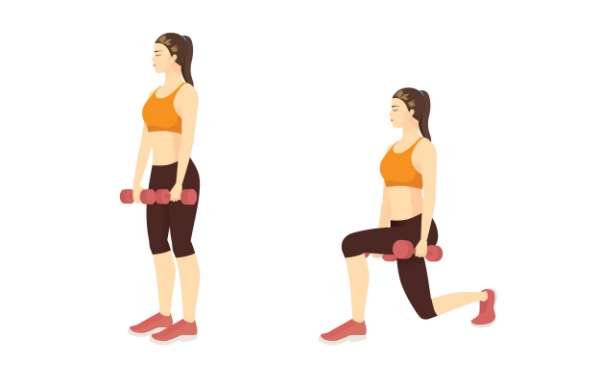
Target muscle group: quadriceps, gluteus maximus
Exercise description: Hold a dumbbell in each hand at your sides with your chest upright, shoulders back and core engaged. Step one foot straight back into a lunge, lowering your body until both knees are bent at about 90 degrees, with your front knee stacked over your ankle and your back knee hovering just above the floor. Keep your weight centered through the heel of the front foot and avoid leaning forward. Press through the front heel to return to standing, then repeat on the opposite side. Maintain controlled movement throughout and keep your hips square for proper form and balance.
2. DB stiff-legged deadlift
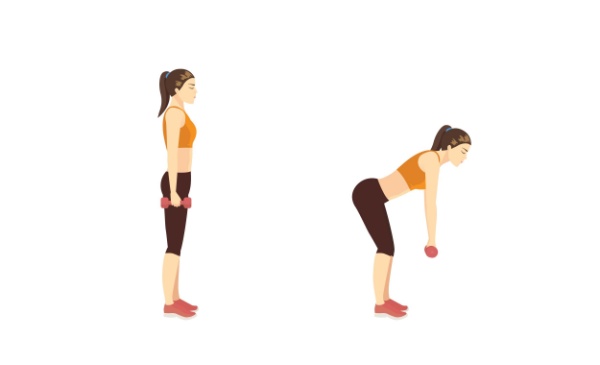
Target muscle group: hamstrings
Exercise description: Hold a dumbbell in each hand with your arms extended in front of your thighs, feet hip-width apart and knees slightly bent. Keeping your spine neutral and core engaged, hinge at the hips by pushing them back as you lower the dumbbells toward the floor, allowing them to track close to your legs. Lower until you feel a strong stretch through your hamstrings while maintaining a flat back and stable knees. Drive your hips forward and squeeze your glutes to return to standing, keeping the movement slow and controlled throughout.
3. DB chest press
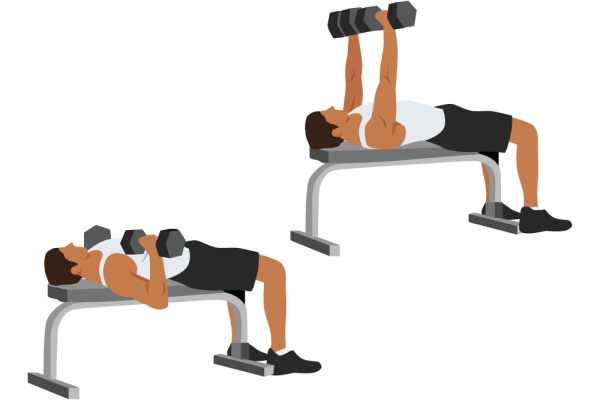
Target muscle group: pectoralis major
Exercise description: Lie on a flat bench holding a dumbbell in each hand, feet planted firmly on the floor. Start with the dumbbells at chest level, elbows bent and slightly angled away from the body, and wrists stacked over your elbows. Engage your core and press the dumbbells upward until your arms are extended but not locked out, keeping the weights aligned over your shoulders. Slowly lower the dumbbells back to the starting position with control, maintaining steady tension through the chest and keeping your shoulders down and back throughout the movement.
4. DB one-arm back row
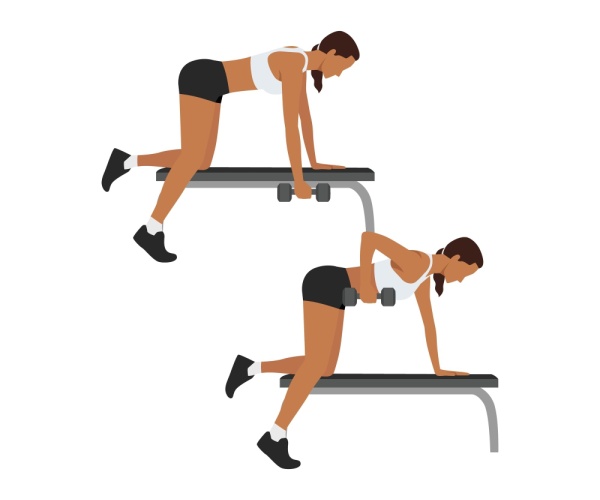
Target muscle group: rhomboids (mid-back)
Exercise description: Hold a dumbbell in one hand and place the opposite knee and hand on a bench for support, keeping your back flat and core engaged. Let the dumbbell hang straight down from your shoulder with your arm fully extended. Pull the weight up toward your hip by driving your elbow back and squeezing your shoulder blade, keeping your torso stable and avoiding rotation. Lower the dumbbell slowly with control to the starting position, then repeat before switching sides.
5. DB shoulder press
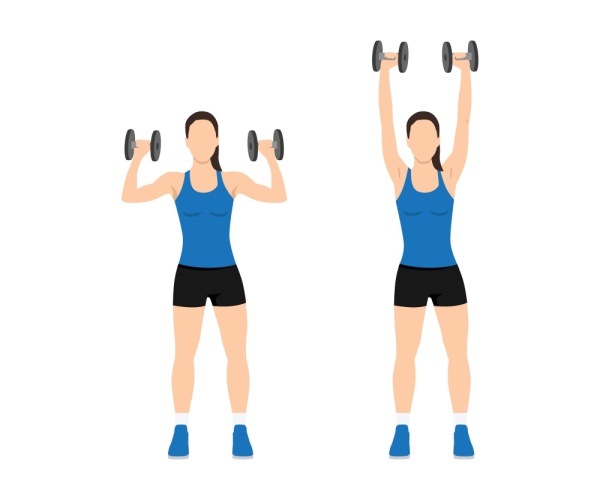
Target muscle group: deltoids
Exercise description: Hold a dumbbell in each hand at shoulder height with your palms facing forward or slightly inward, elbows bent and positioned just below the wrists. Stand with feet shoulder-width apart or sit upright on a bench, engaging your core and keeping your chest tall. Press the dumbbells upward until your arms are fully extended overhead without locking the elbows, keeping the weights aligned over your shoulders. Slowly lower the dumbbells back to shoulder level with control, maintaining stable posture and relaxed neck positioning throughout the movement.
6. DB alternate biceps curl
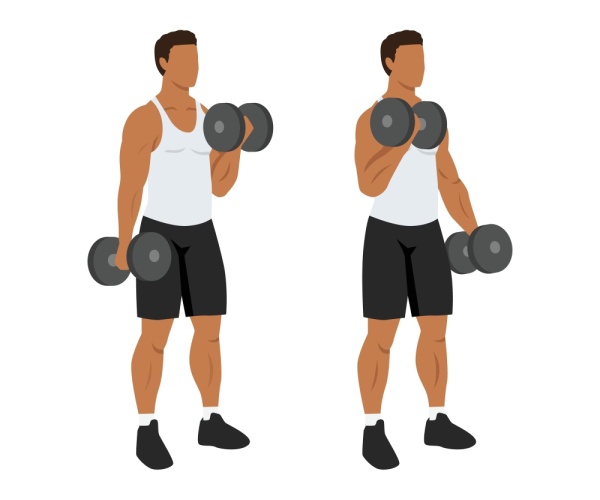
Target muscle group: biceps
Exercise description: Stand tall holding a dumbbell in each hand at your sides with palms facing forward and arms fully extended. Keeping your elbows close to your torso and core engaged, curl one dumbbell upward by bending the elbow and contracting the biceps, rotating the palm toward the shoulder as you lift. Lower the dumbbell slowly back to the starting position with control, then repeat on the opposite arm. Continue alternating sides while maintaining good posture and avoiding momentum or swinging.
7. DB lying triceps press
Target muscle group: triceps
Exercise description: Lie flat on a bench holding a dumbbell in each hand with your arms extended straight up over your shoulders, palms facing each other. Keep your upper arms stationary and perpendicular to the floor as you slowly bend your elbows, lowering the dumbbells toward the sides of your head. Pause briefly when the elbows are fully bent, then extend the arms to press the dumbbells back to the starting position by contracting the triceps. Maintain a neutral wrist position and controlled tempo throughout the movement.
8. Knee-up
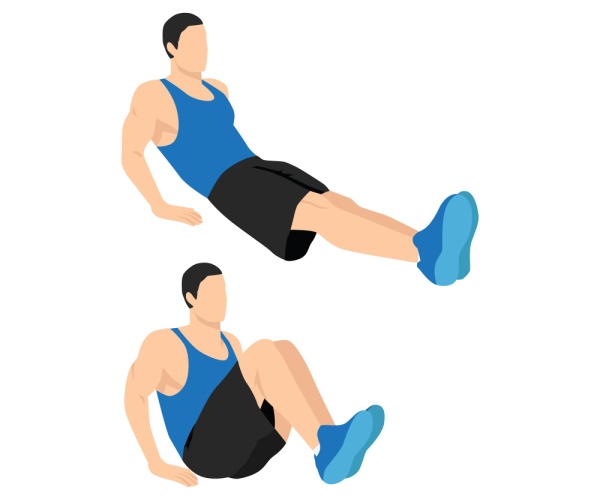
Target muscle group: lower abs
Exercise description: Lie flat on your back with your arms at your sides or holding onto a bench or mat for support. Extend your legs straight out and engage your core by gently pressing your lower back into the floor. Draw your knees up toward your chest by contracting the lower abdominals, lifting your hips slightly off the floor at the top of the movement. Slowly lower your legs back to the starting position with control, keeping tension in the abs and avoiding momentum throughout the exercise.
9. Crossover crunch
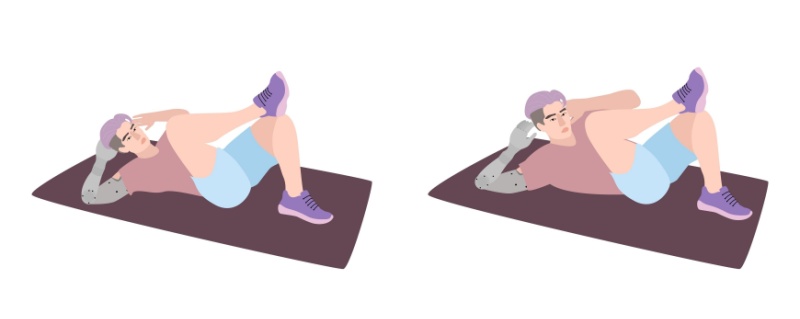
Target muscle group: rectus abdominis, internal and external obliques
Exercise description: Lie on your back with your knees bent and feet flat on the floor, hands lightly supporting your head without pulling on your neck. Engage your core and lift your shoulders off the floor as you rotate your torso, bringing one elbow toward the opposite knee. Focus on squeezing the obliques as you crunch up and across the body. Lower back down with control and repeat on the opposite side, alternating sides while keeping movements slow and deliberate.
10. Alternate lying superman
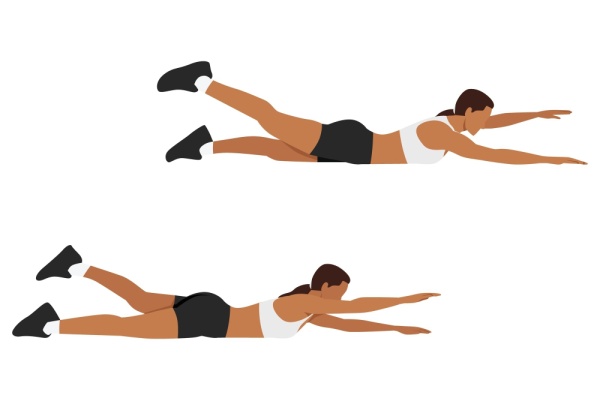
Target muscle group: spinal erectors
Exercise description: Lie face down on the floor with your arms extended overhead and legs straight, keeping your neck neutral and core engaged. Lift one arm and the opposite leg off the floor at the same time, focusing on squeezing the glutes and upper back while keeping your hips and shoulders stable. Hold briefly at the top, then lower back down with control. Alternate sides and continue in a slow, controlled manner, avoiding excessive arching of the lower back.
WORKOUT B: Strength training at a gym for beginners
1. Leg press
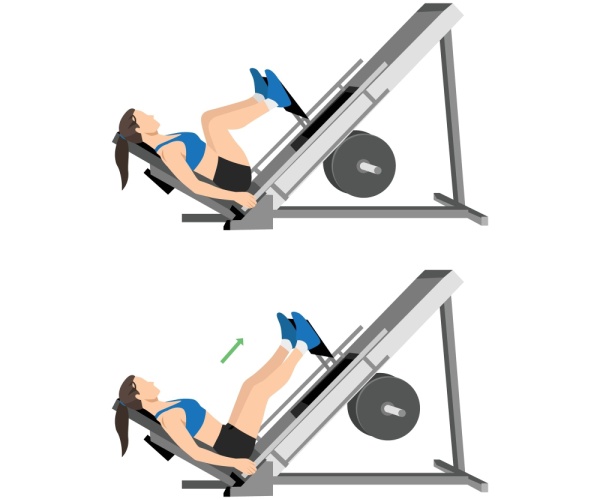
Target muscle group: quadriceps, gluteus maximus
Exercise description: Sit in the leg press machine with your back and head firmly against the padded support and feet placed shoulder-width apart on the platform. Position your feet so your heels stay flat and your knees track in line with your toes. Release the safety handles and lower the platform by bending your knees until they reach about a 90-degree angle, keeping your lower back pressed into the seat. Press through your heels to extend your legs and return the platform to the starting position without locking out your knees, maintaining controlled movement throughout.
2. Leg curl
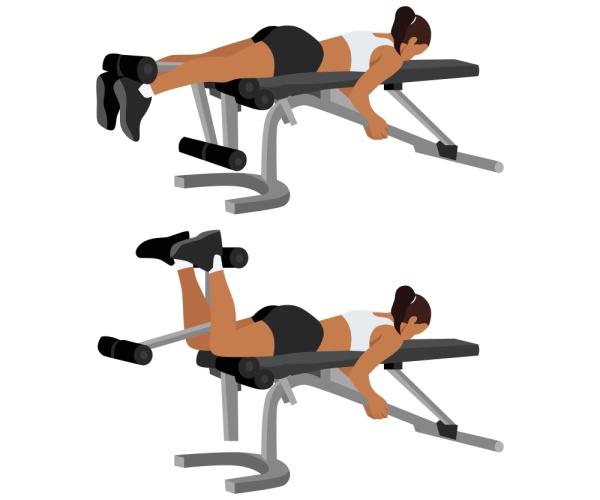
Target muscle group: hamstrings
Exercise description: Adjust the leg curl machine so the pad rests comfortably just above your heels and your knees align with the machine’s pivot point. Lie face down (or sit upright, depending on the machine) with your core engaged and hips pressed into the pad. Curl your legs by bending at the knees and pulling the pad toward your glutes, squeezing the hamstrings at the top of the movement. Slowly lower the weight back to the starting position with control, maintaining steady tension and proper alignment throughout the exercise.
3. Chest machine press
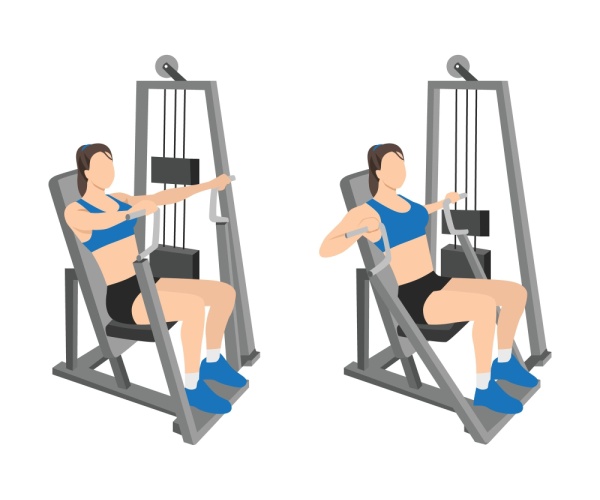
Target muscle group: pectoralis major
Exercise description: Sit in the chest press machine with your back firmly against the pad and feet flat on the floor. Adjust the seat so the handles align with the middle of your chest. Grasp the handles with elbows bent and positioned slightly below shoulder level. Press the handles forward until your arms are extended without locking the elbows, keeping your shoulders down and back. Slowly return to the starting position with control, maintaining steady tension through the chest muscles throughout the movement.
4. Lat pulldown machine
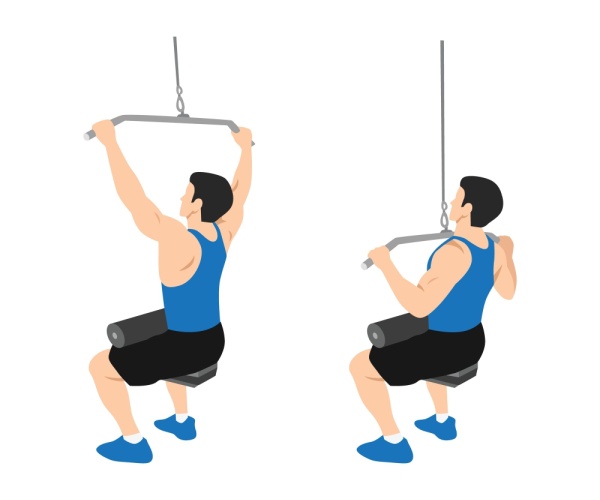
Target muscle group: latissimus dorsi
Exercise description: Sit at the lat pulldown station with your thighs secured under the pads and feet flat on the floor. Grasp the bar with a wide or shoulder-width grip, palms facing forward. Sit tall with your chest lifted and core engaged, then pull the bar down toward your upper chest by driving your elbows down and back while squeezing your shoulder blades together. Slowly return the bar to the starting position with control, allowing your arms to fully extend without shrugging your shoulders.
5. Shoulder press machine
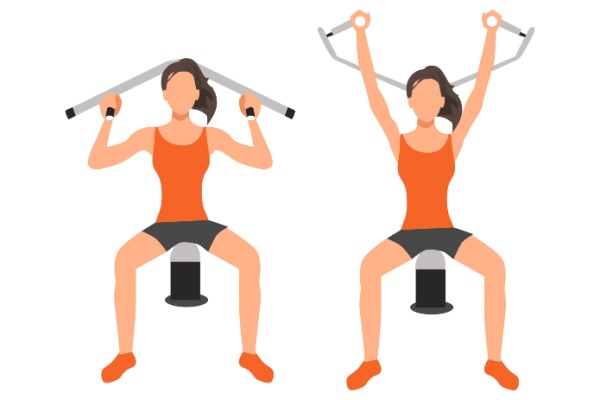
Target muscle group: deltoids
Exercise description: Sit in the shoulder press machine with your back firmly against the pad and feet flat on the floor. Adjust the seat so the handles are at or just below shoulder height. Grasp the handles with palms facing forward or inward, and engage your core while keeping your shoulders down and back. Press the handles upward until your arms are extended overhead without locking the elbows. Slowly lower the handles back to the starting position with control, maintaining proper posture and steady tension throughout the movement.
6. Cable curl
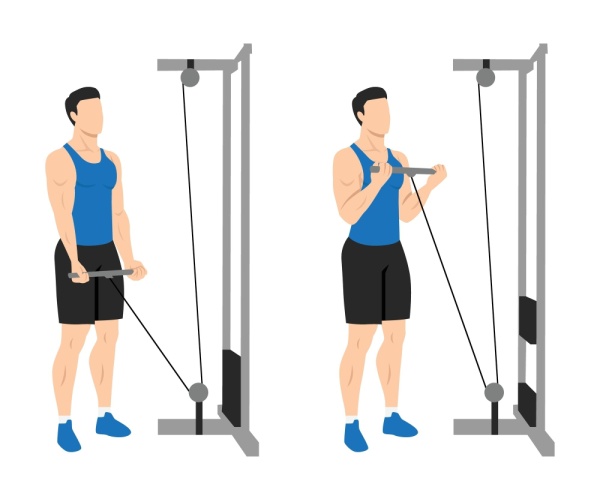
Target muscle group: biceps
Exercise description: Stand facing a low cable pulley with feet hip-width apart and grasp the bar or handles with palms facing up. Keep your elbows tucked close to your sides, chest tall and core engaged. Curl the handle upward by bending at the elbows and squeezing the biceps at the top of the movement. Slowly lower the weight back to the starting position with control, maintaining constant tension and avoiding momentum throughout the exercise.
7. Triceps cable pressdown
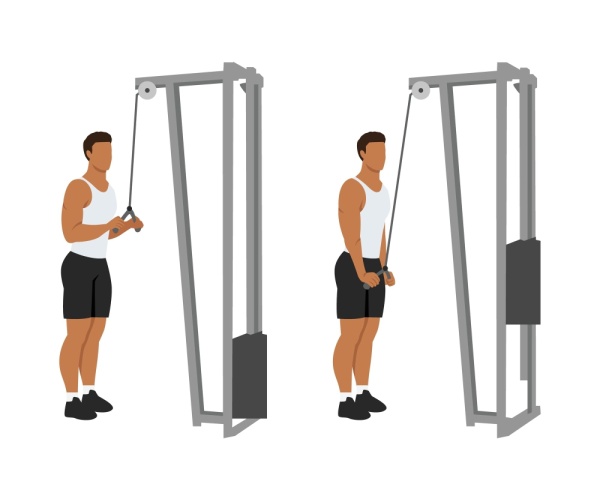
Target muscle group: triceps
Exercise description: Stand facing a high cable pulley and grasp the bar or rope with palms facing down or neutral. Keep your elbows tucked close to your sides, chest lifted and core engaged. Press the handle downward by extending your elbows, fully contracting the triceps at the bottom of the movement without locking out. Slowly return the handle to the starting position with control, keeping your upper arms stationary and maintaining constant tension throughout the exercise.
8. Knee-up (same as home workout)
9. Crossover crunch (same as home workout)
10. Lying superman (same as home workout)
In order to avoid risk of injury, please seek advice directly from your physician, especially if you have existing medical issues, before beginning any exercise program.
Ethan Boldt is the head of content at Ancient Nutrition, is co-author of the book 5-Factor Fitness and was a former Certified Personal Trainer (CPT) by the National Strength and Conditioning Association.
Related Articles
July 10, 2026
|health
How to Help Tone Your Body: Do’s and Don’ts
When it comes to our physique and how we’d like it to look, you don’t hear the terms “muscular” or certainly “ripped.” Instead, many of us simply want to look and feel more “toned.”
December 8, 2025
|health
Best Types of Protein Powder for Muscle Health, Weight Management, Plus Healthy Skin and Joints
There’s many types of protein powder. If you go into a supplement store of some kind, it can quickly become overwhelming with the variety, the claims and trying to figure out what might be best for you, including helping you with your health goals but also something that you will enjoy consuming.
October 15, 2025
|health
8 Benefits of Protein and How Much You Need
Everyone is talking about protein these days, as so many have discovered the benefits go beyond helping to build muscle and extend to keeping hunger at bay, curbing cravings, healthy weight management, bone health and more. In addition, protein helps you preserve muscle as you age.
November 26, 2025
|health
How to Habit Stack for Improved Success, Including with Your Health
Building healthier habits doesn’t have to feel overwhelming. In fact, one of the most effective ways to create lasting change is to keep things smaller and attach new habits to the ones you’re already doing naturally. This powerful technique is called habit stacking, and it’s quickly becoming one of the most recommended tools for improving health, productivity, nutrition, relationships and more.




- © 2010-26 Ancient Brands, LLC. All rights reserved.
- Terms of Use
- Privacy Policy
- CPRA Privacy Policy/Notice of Collection
- Do Not Sell or Share My Personal Information
- Consumer Health Data Privacy Policy